Ductless Mini-Splits: Where They Make Sense in an Older House
No ducts means no duct problems, and that can solve a stubborn room, an addition, or a whole older house.
October 14, 2026 · 4 min read
Older houses have a way of defeating central air. The home was built before anyone planned for ducts, or an addition got tacked on later, or a sunroom bakes every afternoon while the rest of the house is fine. A ductless mini-split is one of the cleanest answers to those problems. It isn't the right answer everywhere, so here is where it fits and where it doesn't.
How a ductless system works
A mini-split has two main parts. An outdoor unit, much like the condenser on a central system, sits on a pad or a bracket outside. An indoor unit, usually mounted high on a wall, handles the air in the room. A small bundle of refrigerant line, power and a condensate drain runs between them through a hole in the wall about the size of a coffee can. No ductwork is needed anywhere.
Each indoor unit controls its own room or zone with its own remote or thermostat. You cool the room you're in instead of the whole house. And because there are no ducts, the air isn't traveling through an attic or crawl space before it reaches you, which is where a lot of central air quietly loses its effect. Many ductless models can also heat, so if you want one for the winter too, ask for a model that does both.
Where they make sense
- Additions and bonus rooms: the existing system was never sized for the extra space, and extending the ducts can be difficult or impossible.
- Sunrooms and converted garages: rooms with lots of glass or poor insulation that central air can't keep up with.
- Older homes without ducts: houses heated by radiators, wall units or old floor furnaces, where cutting in a full duct system would mean tearing into plaster and framing.
- Problem rooms: the upstairs bedroom that is always hotter than downstairs, or the room at the end of a long duct run.
- Workshops and small offices: spaces that get used on their own schedule and don't need the whole building conditioned.
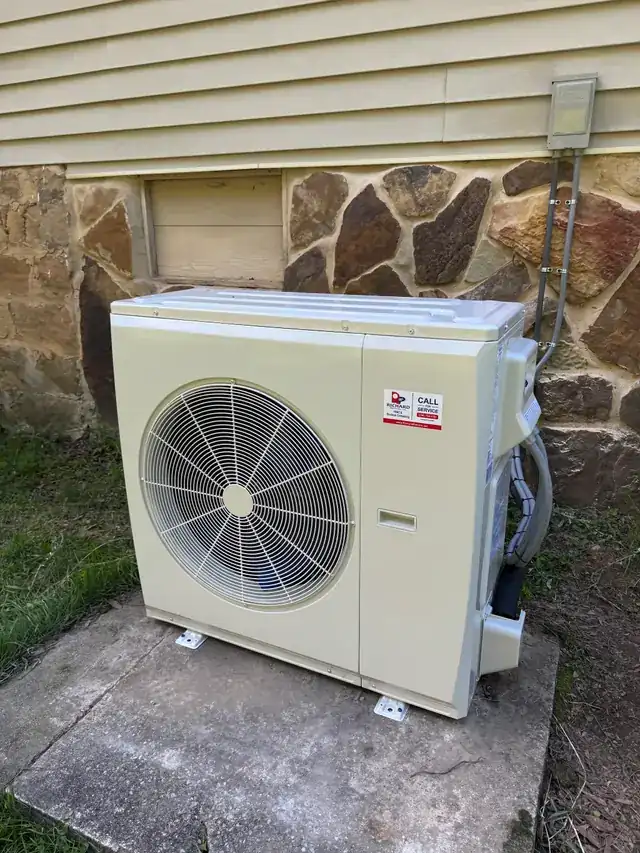
The photo with this article shows a ductless condenser on a stone-faced home, one of the real jobs Richard Electric has done. Notice that the outdoor unit is small and sits low against the wall. That's typical, and it is a big part of why these systems fit on older houses with limited space and finished surfaces.
Where they fall short
Mini-splits are not magic. The wall-mounted indoor unit is visible, and some people don't like how it looks, though the units are slimmer than they used to be. Each indoor unit serves its own space, so a house with many closed-off rooms may need several heads, and the cost and the number of line sets add up. At some point, a single central system with good ducts is the sensible choice instead.
Placement matters. The indoor unit needs a spot where the air can move across the room without being blocked by a tall cabinet or a door, and the line set needs a reasonable path to the outdoor unit. A room with a closed door and no airflow between spaces may need its own unit rather than borrowing from the next room. And the electrical supply has to support the equipment, which on an older home sometimes means upgrading a circuit or the panel.
Questions to ask before you decide
- Which rooms are actually the problem, and is it heat, cold, or both?
- Would one unit handle the space, or does the layout call for more than one?
- Is my panel ready for the added circuit?
- Where will the indoor and outdoor units go, and how will the line set run?
- Is a ductless system the better fit here, or would repairing or adding to my ducts do the job?
That last question deserves an honest answer. Richard Electric installs ductless split systems, and it also fabricates and installs ductwork and repairs and replaces central air, so the company has no reason to push one approach. Sometimes the answer is a mini-split for the sunroom and nothing else. Sometimes it's fixing the ducts you already have. A walk through the house will tell you more than a catalog.
Sizing and installation
The most common mistake with mini-splits is buying a unit by square footage alone. Sun exposure, insulation, window area, ceiling height and how the room is used all change how much capacity it needs. A unit too small never catches up. A unit too big cools quickly, shuts off, and leaves the room clammy. A proper load calculation by someone who has seen the space avoids both.
Installation matters as much as the equipment. Line sets have to be flared or connected correctly, the system has to be evacuated and charged properly, and the condensate has to drain somewhere that makes sense. Those details are invisible after the job, but they decide whether the system runs well for ten years or gives you trouble in two. Richard Electric's technicians handle the HVAC side and the electrical side, and the company offers extended warranties on new installs.
If you have a room, an addition or an older house that central air has never handled well, call Richard Electric at (256) 600-0616 and ask whether a ductless system makes sense. You can also look over the cooling services at /cooling.
Richard Electric Company, Inc., (256) 600-0616
Call (256) 600-0616More articles
Heat Pump or Gas Furnace: What a North Alabama Winter Asks of Each
Both will keep a Cullman County house warm, but they get there differently, and your house decides which one fits.
What a Twice-a-Year Maintenance Visit Actually Checks, and Why Twice
A good maintenance visit is a documented inspection, not a quick look and a handshake.